Sending Money Home: How to Stop Losing 6% to Fees
The advertised fee is not the price. Here is how the exchange-rate margin works, four ways to pay less, and the federal rights you have on every transfer sent from the United States.

Olga Burninova
Founder & CEO, YPA-FINANCE
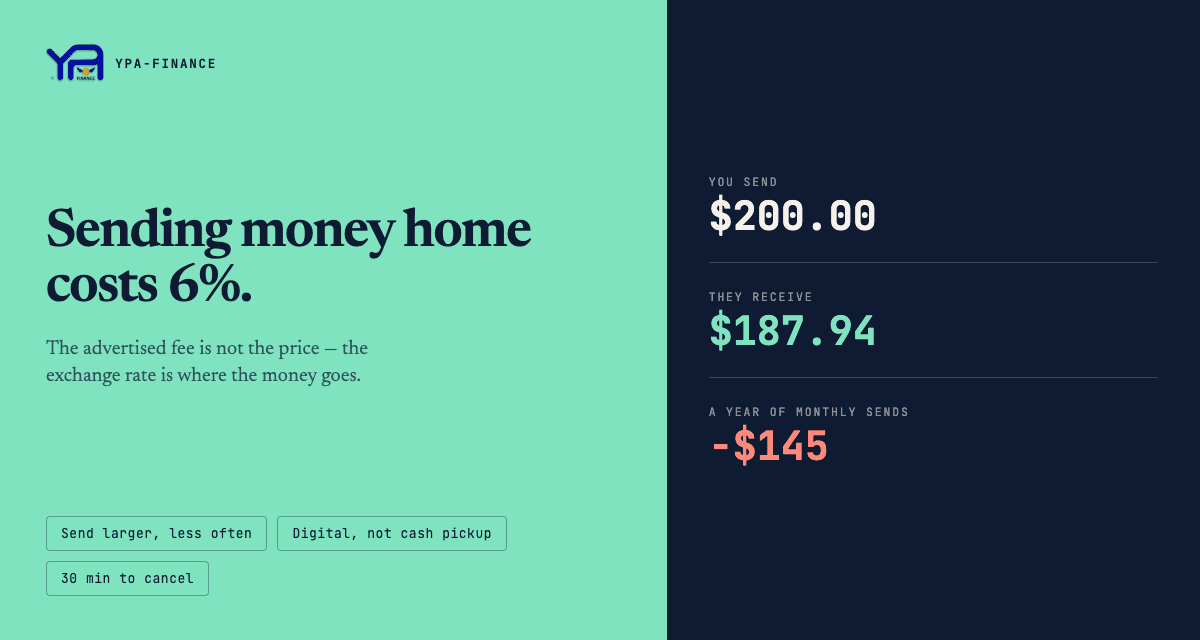
Sending $200 from the US costs an average of 6.03% once fees and exchange-rate margin are counted, double the 3% international target. Compare providers on how much actually arrives, send larger amounts less often, use digital rather than cash pickup, and remember you can cancel most transfers within 30 minutes under the CFPB remittance rule.
Sending $200 home from the United States costs an average of 6.03 percent of the amount sent. That is the World Bank's figure for the third quarter of 2024, and it is double the 3 percent target the UN set under Sustainable Development Goal 10.c (World Bank).
Six percent does not sound like much until you annualise it. Send $200 every month and roughly $145 a year disappears into fees and exchange-rate margin. Over five years that is a used car.
This is not a small or unusual behaviour. In 2023, 16.1 percent of foreign-born noncitizen households in the US sent or received an international remittance through a nonbank provider, against 1.0 percent of US-born households (FDIC). Our 2026 data report sets that alongside what those transfers cost.
The fee you see is not the price you pay
Every transfer has two costs, and providers advertise the smaller one.
The fee is the number on the screen. Sometimes it is genuinely zero.
The exchange-rate margin is the difference between the rate you get and the real mid-market rate, the one you would see if you searched the currency pair. A provider that charges $0 in fees and takes 3 percent on the rate is more expensive than one charging $5 with a fair rate.
The only comparison that means anything is the one at the other end: how much money arrives. Not the fee, not the rate, not the promotional banner. Ask each provider what the recipient receives, for the exact amount, on the exact day.
Four ways to pay less, in order of how much they save
Send larger amounts, less often. Fixed fees weigh far more heavily on small transfers. The World Bank measures two sizes, and the gap is large: sending $200 from the US averaged 6.03 percent, while sending $500 averaged 4.22 percent. Moving the same money in fewer, larger transfers cuts roughly 30 percent off the percentage cost, provided the family at the other end can manage a less frequent rhythm.
Use digital rather than cash-to-cash. Globally, digital remittances are consistently cheaper than non-digital ones. Cash pickup is the most expensive way to move money, because someone has to staff a counter at both ends. If the recipient has a bank account or a mobile wallet, use it.
Compare on a fixed day, in a fixed amount. Rates move. Comparing "roughly $300" between two providers on two different afternoons tells you nothing. Pick the number, open both apps within a few minutes, and write down what arrives.
Check first-transfer promotions carefully. A great rate on the first transfer followed by a poor one afterwards is a common design. Compare the standard rate, not the welcome rate.
If you want a starting point for the comparison, we have written up two of the largest providers in detail: YPA-FINANCE vs Wise and YPA-FINANCE vs Remitly.
Your legal rights when you send money abroad
Most people do not know that money sent from the United States to another country is covered by a specific federal rule, the CFPB's remittance transfer rule under Regulation E. If you send more than $15 abroad through a company that does this regularly, you are entitled to:
If a provider will not tell you in advance what the recipient will receive, that is not a quirk of their app. It is a signal to use someone else. You can read the rule itself on the CFPB's site.
A checklist before you press send
The part nobody puts on the pricing page
Remittances are usually sent out of an income that is also carrying US costs: rent, a credit card, sometimes debt at 22 percent interest. Sending money home is not optional for most families, but the sequence matters. A month where you send $400 abroad and pay the minimum on a card at 22 percent APR moves money out of the household twice.
If that describes your situation, work out the real cost of the debt before deciding what to send. Our free credit card payoff calculator shows exactly what a balance costs per month and what changes if you pay a little more, so the decision is made with a number rather than a feeling. And if the debt is the pressing problem, how to pay off credit card debt fast sets out the order of operations.
Common questions
What is the average cost of sending money from the US?
Sending $200 from the United States cost an average of 6.03 percent in Q3 2024, and sending $500 cost 4.22 percent, according to the World Bank's Remittance Prices Worldwide database. The international target is 3 percent.
Why is the exchange rate different from the one I see online?
The rate you see when you search a currency pair is the mid-market rate. Most providers apply a margin to it, and that margin is part of the price even when the advertised fee is zero.
Can I cancel an international transfer?
Usually yes. Under the CFPB remittance rule you can cancel most transfers within 30 minutes of paying, provided the recipient has not already collected the money, and receive a refund within three business days.
Is it cheaper to send money through a bank?
Rarely. Banks are consistently the most expensive channel in the World Bank's data. Digital providers are consistently the cheapest.
Does sending remittances affect my credit score?
No. Remittances are not reported to the credit bureaus and do not appear on a credit file, in either direction.
Should I send more money less often?
If the household at the other end can manage the timing, usually yes. Fixed fees fall much more heavily on small transfers, which is why the average cost of a $500 transfer is well below that of a $200 one.
Before your next transfer, run the numbers: our free remittance cost calculator compares providers on the fee and the exchange-rate margin together.
YPA-FINANCE helps immigrants and newcomers understand credit score, budgeting, and debt payoff in 13 languages, with simple tools, plain language, and support that feels human.
Related Articles
What Is an ITIN and How Do You Get One?
An ITIN is a tax number, not a work permit and not an ID. Here is exactly what it does, who needs one, how to apply on Form W-7 without mailing your passport, and which tax credits stay out of reach without an SSN.
How to Open a US Bank Account Without a Social Security Number
Federal rules were written with your case in mind: a bank can accept a passport or consular ID instead of an SSN. Here is what to bring, where to try first, and what to do when a branch says no.
Filing Your First US Tax Return as an Immigrant
The first US return freezes a lot of newcomers because the forms assume you know your category. Here is how to work out whether you are a resident for tax purposes, which form that means, and where to get free help.
About this page
Written and reviewed by Olga Burninova, Founder & CEO, YPA-FINANCE. Last reviewed: .
How we write and review our content
Spot an error? Email hello@ypa.finance.