How to Open a US Bank Account Without a Social Security Number
Federal rules were written with your case in mind: a bank can accept a passport or consular ID instead of an SSN. Here is what to bring, where to try first, and what to do when a branch says no.

Olga Burninova
Founder & CEO, YPA-FINANCE
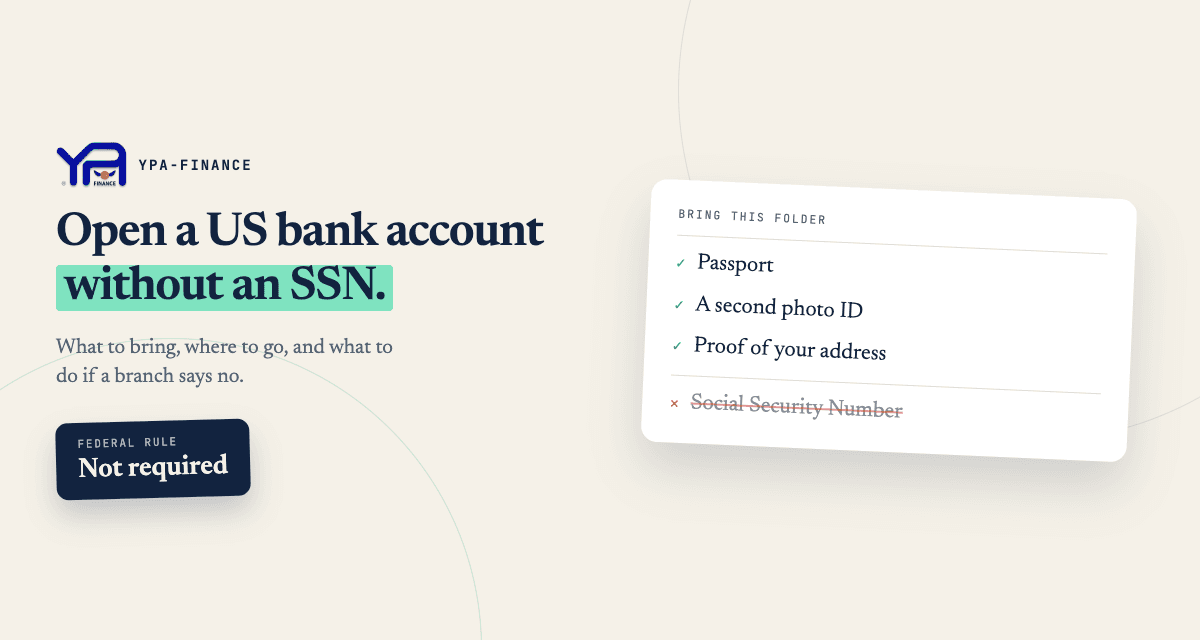
You can open a US bank account without a Social Security Number. Federal identification rules let a bank accept a passport number, an alien identification card, or another government-issued photo document for a non-US person. Bring a passport, a second ID, proof of address, and an ITIN if you have one, and start with a credit union, a CDFI, or a Bank On certified account.
You can open a US bank account without a Social Security Number. Federal rules were written with that case in mind, and they say so explicitly. The obstacle is almost never the law. It is that the person at the counter has been trained on the ordinary case, and yours is not it.
This matters more than it sounds. In 2023, 14.3 percent of foreign-born noncitizen households in the United States had no bank account at all, against 3.5 percent of US-born households (FDIC), a gap we cover in full in our 2026 data report on immigrant finance. Being unbanked is expensive: it means check-cashing fees, money orders, and cash you cannot prove you have.
What the law actually requires
Under the federal Customer Identification Program rules, a bank must collect a name, date of birth, address, and an identification number before opening an account. For a US person that number is a Social Security Number or other taxpayer number.
For a non-US person, the rule is written differently. The bank may instead accept:
That is the text of 31 CFR 1020.220. A foreign passport alone can satisfy the identification-number requirement for a non-US person.
Two caveats worth knowing. First, banks are allowed to be stricter than the rule. Nothing forces a particular bank to open your account. Second, each bank sets its own list of acceptable documents, which is why the same paperwork gets refused at one branch and accepted at another.
What to bring
Assemble more than you think you need. A thick folder changes the conversation:
Where to try first
Not every institution is equally likely to say yes.
A practical tip: phone ahead and ask one specific question. "I do not have a Social Security Number. I have a passport and an ITIN. Can you open a checking account for me?" You will learn more in two minutes than in an hour at a counter.
Why people stay unbanked, and what it actually costs
The FDIC asks unbanked households their main reason. In 2023 the answers were:
| Main reason for having no bank account | Share of unbanked households |
|---|---|
| Not enough money to meet minimum balance requirements | 23.3% |
| Do not trust banks | 15.7% |
| Fees are too high | 8.9% |
| Do not have the personal identification required | 5.1% |
| Avoiding a bank gives more privacy | 5.1% |
Two of the top three are about money and fees, and both are answerable: Bank On accounts exist precisely to remove minimum balances and overdraft charges. The identification barrier is real but smaller than people expect, and it is the one this article is about.
The cost of staying outside the system compounds quietly. Check cashers charge a percentage of every cheque. Money orders cost a fee each. Cash income leaves no record, which becomes a problem the day a landlord, a lender, or an immigration process asks you to document it. And a bank account is the anchor most credit products are built on. Only 60.8 percent of foreign-born noncitizen households had a traditional credit card in 2023, against 77.5 percent of US-born households.
After the account is open
Getting the account is the milestone. Keeping it useful takes a few habits:
What to do if you are refused
A refusal at one branch is not a verdict on the system.
Common questions
Is it legal to open a US bank account without an SSN?
Yes. Federal identification rules allow a bank to accept a passport number, an alien identification card, or another government-issued photo document showing nationality or residence for a non-US person instead of a Social Security Number.
Do I need an ITIN to open a bank account?
Not as a legal matter. In practice many banks ask for one because it fits their process more neatly, and having one widens your options.
Which banks accept consular ID cards?
Several large banks and many credit unions do, but policies vary by institution and sometimes by state. Call the branch and ask about your specific document before visiting.
Will opening a bank account affect my immigration status?
Opening a bank account is an ordinary financial act and does not change immigration status. If your situation is complicated, ask an immigration attorney rather than a bank employee.
Can I get a debit card without an SSN?
Yes. A debit card comes with the checking account, so if the account is opened, the card follows.
Does a bank account help me build credit?
Not by itself, because deposit accounts are not reported to the credit bureaus. It is the foundation, though: it is what most secured cards and credit-builder loans are opened against.
YPA-FINANCE helps immigrants and newcomers understand credit score, budgeting, and debt payoff in 13 languages, with simple tools, plain language, and support that feels human.
Related Articles
What Is an ITIN and How Do You Get One?
An ITIN is a tax number, not a work permit and not an ID. Here is exactly what it does, who needs one, how to apply on Form W-7 without mailing your passport, and which tax credits stay out of reach without an SSN.
Sending Money Home: How to Stop Losing 6% to Fees
The advertised fee is not the price. Here is how the exchange-rate margin works, four ways to pay less, and the federal rights you have on every transfer sent from the United States.
Filing Your First US Tax Return as an Immigrant
The first US return freezes a lot of newcomers because the forms assume you know your category. Here is how to work out whether you are a resident for tax purposes, which form that means, and where to get free help.
About this page
Written and reviewed by Olga Burninova, Founder & CEO, YPA-FINANCE. Last reviewed: .
How we write and review our content
Spot an error? Email hello@ypa.finance.