Filing Your First US Tax Return as an Immigrant
The first US return freezes a lot of newcomers because the forms assume you know your category. Here is how to work out whether you are a resident for tax purposes, which form that means, and where to get free help.

Olga Burninova
Founder & CEO, YPA-FINANCE
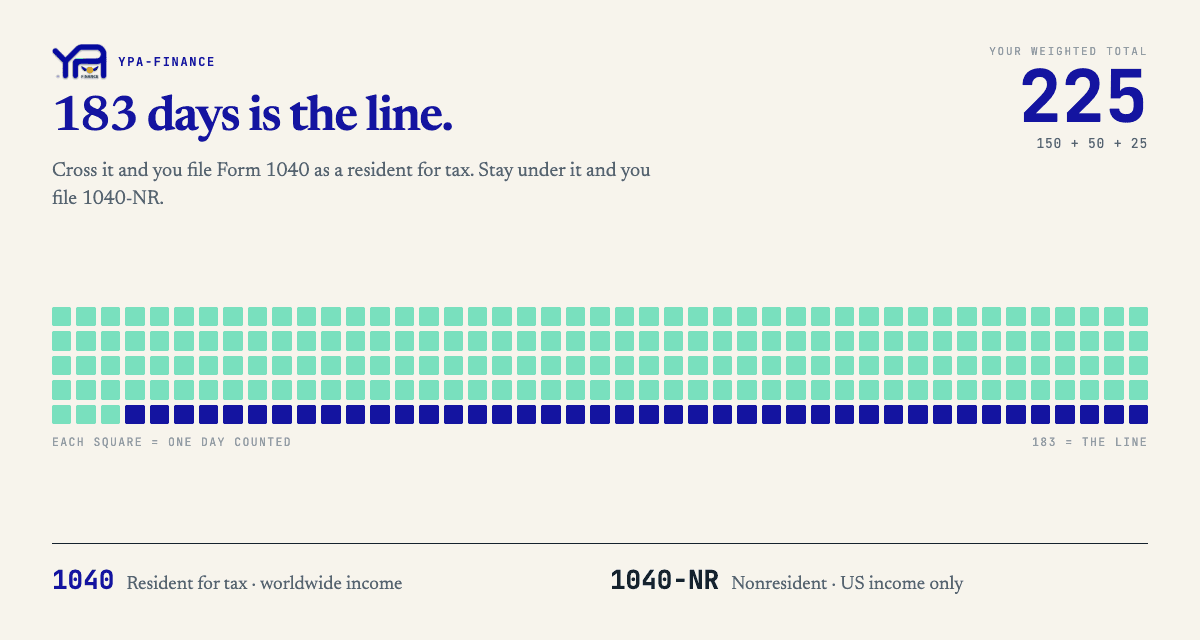
US tax law sorts people into residents and nonresidents, not citizens and foreigners. Work out which you are with the substantial presence test (31 days this year and 183 across three years, weighted), then file Form 1040 as a resident or Form 1040-NR as a nonresident. You can file with an ITIN, but the EITC and Child Tax Credit both require an SSN.
The first US tax return is where a lot of newcomers freeze. The forms assume you already know which category you belong to, and the category is not the one you would guess: for tax purposes, the US does not sort people into citizens and foreigners. It sorts them into residents and nonresidents, and a person on a temporary visa can easily be a resident for tax while being a nonresident for immigration.
Get that one classification right and most of the rest follows.
Step 1: work out whether you are a resident for tax purposes
You are a resident for tax purposes if you hold a green card, or if you meet the substantial presence test. The test has two parts, and you must satisfy both (IRS):
An example. You were in the US for 150 days this year, 150 last year and 150 the year before. That is 150 + 50 + 25 = 225. Over 183, so you are a resident for tax purposes.
Some people do not count their days at all. Students on F, J, M or Q visas and teachers or trainees on J or Q visas are exempt individuals for a limited number of years, meaning their days of presence are excluded from the test. They generally have to file Form 8843 to claim that status, even in a year with no income.
Step 2: the classification decides the form
Filing the wrong one is one of the most common newcomer mistakes, and it is worth fixing rather than ignoring, because it changes what you owe and what you can claim.
Step 3: get a taxpayer number
You cannot file without one. If you are eligible for a Social Security Number, use it. If you are not, you need an ITIN, and the application (Form W-7) is normally filed together with the tax return itself, not before it. Allow 7 weeks for the IRS to respond, or 9 to 11 weeks during filing season. The full process is in what an ITIN is and how to get one.
Step 4: gather the documents
Most first returns need less paperwork than people fear:
Employers must send W-2s by 31 January. If one does not arrive, the employer is the first call, and the IRS is the second.
Step 5: know which credits your number allows
This is where families lose the most money without realising it. Two of the largest US tax credits are closed to ITIN filers:
| Credit | Available with an ITIN? | Rule |
|---|---|---|
| Earned Income Tax Credit | No | You, your spouse, and each qualifying child must have an SSN issued by the return due date |
| Child Tax Credit | No | The qualifying child must have an SSN |
| Credit for Other Dependents | Yes | The dependent needs an SSN, ITIN or ATIN by the return due date |
| American Opportunity / Lifetime Learning | Yes | You and the student each need a TIN (SSN, ITIN or ATIN) issued by the return due date, including extensions. Nonresident filers generally cannot claim them |
If someone in the household later receives an SSN, ask a qualified preparer whether an amended return for a still-open year makes sense.
Step 6: file, and file for free if you can
The deadline for most individual returns is 15 April. If you cannot make it, an extension gives you more time to file, but not more time to pay: any tax owed is still due in April.
Free help is genuinely free and genuinely good:
Paid preparers who advertise "instant refunds" are usually selling a loan against your refund. The refund is already coming. Paying for it early is expensive.
Why filing is worth it even when you owe nothing
Newcomers often assume that a small income means filing is pointless. Three reasons it is not:
Mistakes to avoid on a first return
Common questions
Do I have to file a US tax return if I am not a citizen?
If you have US-source income or meet the substantial presence test, generally yes. Immigration status is not what determines the filing obligation; presence and income are.
Can I file taxes without a Social Security Number?
Yes. Apply for an ITIN using Form W-7 and file it together with your return.
What is the difference between Form 1040 and Form 1040-NR?
Form 1040 is for people who are residents for tax purposes and covers worldwide income. Form 1040-NR is for nonresidents and covers US-source income only.
Can I get a refund with an ITIN?
Yes. If more tax was withheld from your pay than you owe, filing is how you claim the difference back, whether you file with an SSN or an ITIN.
Is free tax help actually free?
Yes. VITA and TCE are IRS-sponsored programmes staffed by certified volunteers, and IRS Free File offers free filing software below an income threshold.
What happens if I miss the April deadline?
File as soon as you can. Penalties for filing late are generally larger than penalties for paying late, so filing quickly limits the damage even if you cannot pay the full amount straight away.
YPA-FINANCE helps immigrants and newcomers understand credit score, budgeting, and debt payoff in 13 languages, with simple tools, plain language, and support that feels human.
Related Articles
What Is an ITIN and How Do You Get One?
An ITIN is a tax number, not a work permit and not an ID. Here is exactly what it does, who needs one, how to apply on Form W-7 without mailing your passport, and which tax credits stay out of reach without an SSN.
How to Open a US Bank Account Without a Social Security Number
Federal rules were written with your case in mind: a bank can accept a passport or consular ID instead of an SSN. Here is what to bring, where to try first, and what to do when a branch says no.
Sending Money Home: How to Stop Losing 6% to Fees
The advertised fee is not the price. Here is how the exchange-rate margin works, four ways to pay less, and the federal rights you have on every transfer sent from the United States.
About this page
Written and reviewed by Olga Burninova, Founder & CEO, YPA-FINANCE. Last reviewed: .
How we write and review our content
Spot an error? Email hello@ypa.finance.