The Minimum Payment Trap: What Paying Only the Minimum on a Credit Card Really Costs
Paying only the minimum on $3,000 at 24% APR takes 15 years and costs $4,887 in interest. The math, the one statement box to read, and three ways out.

Svetlana Burninova
CTO & Co-Founder
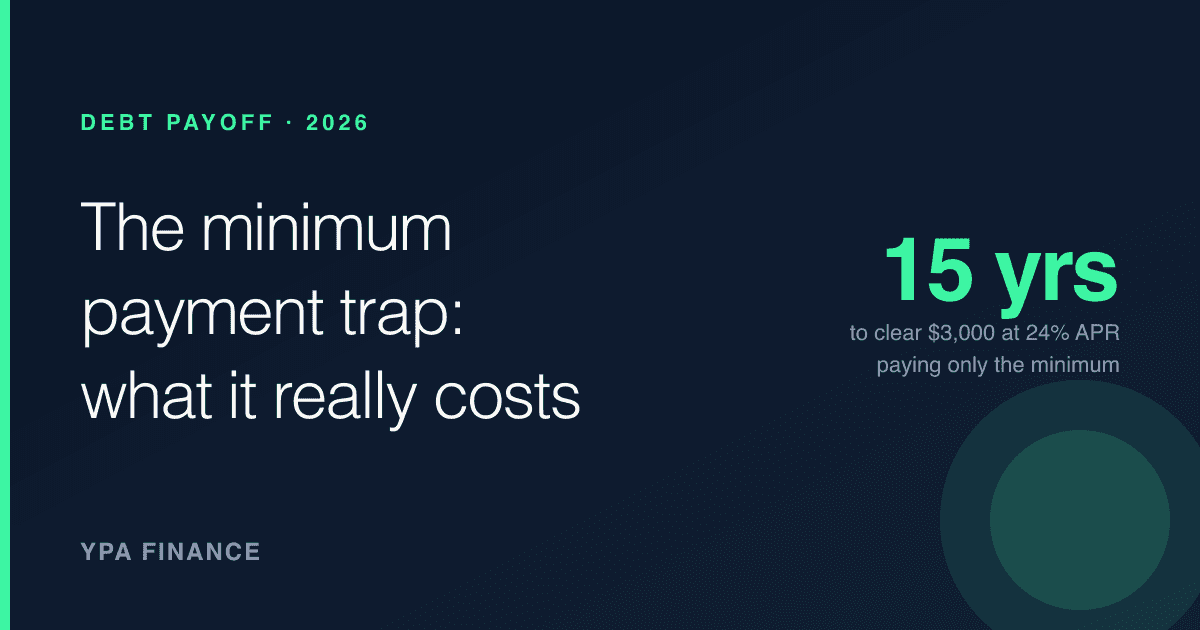
The typical credit card minimum is 1% of the balance plus that month's interest, so about two thirds of it is interest. Paying only the minimum on $3,000 at 24% APR takes 15 years and 3 months and costs $4,887 in interest. Freezing the payment at the first month's minimum ($90) clears the same balance in 4 years and 8 months for $1,993. Every US statement must show a 36-month payoff figure; read it, then set a fixed payment or a target date.
Every credit card statement has a line called the minimum payment. Pay it on time and the issuer is satisfied: no late fee, no penalty rate, no mark on your credit report. It feels like the responsible choice, and in one narrow sense it is.
It is also the most expensive way to use a credit card that exists short of not paying at all. This article shows the actual math, using the same formula as our free credit card payoff calculator, so you can see what the minimum costs on your own balance and what the way out looks like.
How the minimum payment is calculated
Issuers do not publish one shared formula, but the most common one is simple: a small percentage of your balance, usually 1%, plus that month's interest and fees, with a floor of around $25 to $40 so tiny balances still clear. Some issuers use a flat 2% to 3% of the balance instead. The exact rule is in your cardholder agreement, and the CFPB explains how to find it.
Notice what the 1% formula means. If your APR is 24%, your card charges about 2% of the balance in interest every month. The minimum is that 2% plus 1% of the balance. In other words, roughly two thirds of your minimum payment is interest, and only one third reduces what you owe. That ratio is why the balance barely moves.
What paying only the minimum really costs
Here is what happens to five common balances at 24% APR if you pay exactly the minimum (1% of the balance plus interest, $25 floor) every month, never miss, and never charge anything new. The payment shrinks as the balance shrinks, which is exactly what makes it take so long.
| Starting balance | First minimum payment | Time to pay off | Total interest paid |
|---|---|---|---|
| $1,000 | $30 | 6 years, 2 months | $887 |
| $2,000 | $60 | 11 years, 11 months | $2,887 |
| $3,000 | $90 | 15 years, 3 months | $4,887 |
| $5,000 | $150 | 19 years, 6 months | $8,887 |
| $8,000 | $240 | 23 years, 5 months | $14,887 |
A $3,000 balance costs more in interest than you borrowed and takes longer to clear than most car loans. The 24% rate is not an extreme example: the average rate on US credit card accounts that carry a balance has been above 20% since 2023, according to the Federal Reserve's G.19 release. At 29%, which is common for store cards and people with a thin credit file, the $3,000 balance takes 16 years and costs $6,036 in interest.
Why it takes so long: the shrinking payment
The trap is not the first payment. $90 a month on $3,000 is a reasonable number. The trap is that next month the minimum is $89, then $88, and so on, because it is recalculated from the smaller balance. You are always paying the least the issuer allows, and the issuer's formula is built to stretch that out.
Here is the proof. Take the same $3,000 at 24% and simply freeze your payment at $90, the first month's minimum, instead of letting it fall:
| Strategy on $3,000 at 24% APR | Time to pay off | Total interest |
|---|---|---|
| Pay the shrinking minimum | 15 years, 3 months | $4,887 |
| Pay $90 every month (first minimum, frozen) | 4 years, 8 months | $1,993 |
| Pay the minimum plus $50 | 3 years, 9 months | $1,309 |
| Pay a fixed $150 | 2 years, 2 months | $870 |
Same card, same rate, same person. The difference between the first row and the second is nothing but refusing to let the payment shrink. That one decision saves almost $2,900 and ten and a half years.
The one box on your statement worth reading
Since the CARD Act of 2009, every US credit card statement must include a minimum payment warning: how long it will take to pay off the balance at the minimum, and the monthly payment that would clear it in 36 months, with the total cost of each. The CFPB describes the box here.
If English is not your first language and the statement is a wall of text, this is the one box to find. For a $3,000 balance at 24%, the 36-month figure is about $118 a month, and the total interest drops to about $1,232. The issuer is required to print that number. Almost nobody reads it. Our guide to reading a credit card statement walks through where it sits and what the rest of the page means.
Many newcomers have a reason to miss it: in a lot of countries, credit cards work on fixed installments ("cuotas", "parcelas", "raty") that end on a known date. A US revolving card has no end date unless you set one, and the word "minimum" sounds like a plan when it is only a floor.
Three ways out, from easiest to fastest
1. Freeze the payment. Look at this month's minimum, and set an automatic payment for that exact amount, forever. You will not feel the difference in month one. As the table above shows, it cuts the payoff time by about two thirds on its own.
2. Add a fixed amount on top. An extra $50 a month on the $3,000 balance brings the payoff under four years and the interest under $1,400. On $5,000 it turns a 19-year payoff into about five and a half years. The money has to come from somewhere; the 50/30/20 budget adapted for immigrants is one way to find it without cutting remittances home.
3. Pick a finish date and work backwards. Decide when you want to be done, 18 or 24 or 36 months, and let the calculator tell you the payment. The "What payment do I need?" mode of the payoff calculator does exactly this. A deadline you chose is far easier to keep than a shrinking number the issuer chose. If you have more than one card, debt snowball vs. debt avalanche explains which one to attack first, and this guide covers what to do when the cards are already piling up.
When paying the minimum is the right call
The minimum is a floor, not a plan, but there are two situations where it is the correct move:
What the minimum is never for: carrying a balance month after month at 20% or more while money sits in a savings account earning 3% or 4%. The card is costing you five or six times what the savings earn.
Check your own numbers for free
The YPA-FINANCE credit card payoff calculator runs in the browser, needs no account or bank connection, and works in 13 languages, including Spanish, Chinese, Russian, Arabic and Vietnamese. It has three modes:
The tables in this article were produced with the same formula the calculator uses, so what you see there matches what you read here. It is an estimate: your issuer's minimum formula, fees and any rate changes will move the real numbers, and the calculator assumes no new purchases. The exact rules are in your cardholder agreement, and the warning box on your statement is the authoritative figure for your account.
Inside the free app, Calculator PRO connects to your real cards (read-only, through Plaid) and runs the same math on your actual balances and APRs, so the plan updates itself as you pay.
Frequently asked questions
Does paying only the minimum hurt my credit score?
Not directly. Paying at least the minimum on time is reported as a positive payment. What hurts is the high balance it leaves behind: credit utilization, the share of your limit you are using, is a major scoring factor, and minimum-only payers keep utilization high for years.
How is the minimum payment on a credit card calculated?
Most issuers use a percentage of the balance (often 1%) plus the month's interest and fees, with a floor of about $25 to $40. Some use a flat 2% to 3% of the balance. Your cardholder agreement states the exact formula, and every statement shows the resulting amount.
Why does my minimum payment go down each month?
Because it is recalculated from your current balance. As the balance falls, so does 1% of it and the interest on it. That is convenient for the issuer and expensive for you; freezing your payment at the first month's amount is the simplest fix.
What happens if I pay less than the minimum?
The issuer treats it as a missed payment: a late fee, possibly a penalty APR, and after 30 days a delinquency on your credit report. If you cannot pay the full minimum, call the issuer before the due date; hardship programs exist and are far better than a missed payment.
Is it better to pay the minimum or pay nothing in a hard month?
Always the minimum. It keeps the account current and the credit report clean. A single 30-day late payment can cost more in score points and penalty interest than months of minimum payments.
How much more than the minimum should I pay?
As much as you can without missing other bills, and at the very least the same amount every month. Even an extra $25 or $50 a month shortens a 15-year payoff to under six years on a $3,000 balance at 24%. Use the payoff calculator to see the exact effect of any amount.
YPA-FINANCE helps immigrants and newcomers understand credit scores, budgets and debt payoff in 13 languages, with simple tools, clear language, and human support.
Related Articles
About this page
Written and reviewed by Svetlana Burninova, CTO & Co-Founder, YPA-FINANCE. Last reviewed: .
How we write and review our content
Spot an error? Email hello@ypa.finance.