How to Get Financially Ready to Buy a Home as a Newcomer
Before you apply for a mortgage: build the credit lenders want, save the right down payment, and get your documents in order, as a newcomer with an SSN or ITIN.

Svetlana Burninova
CTO & Co-Founder
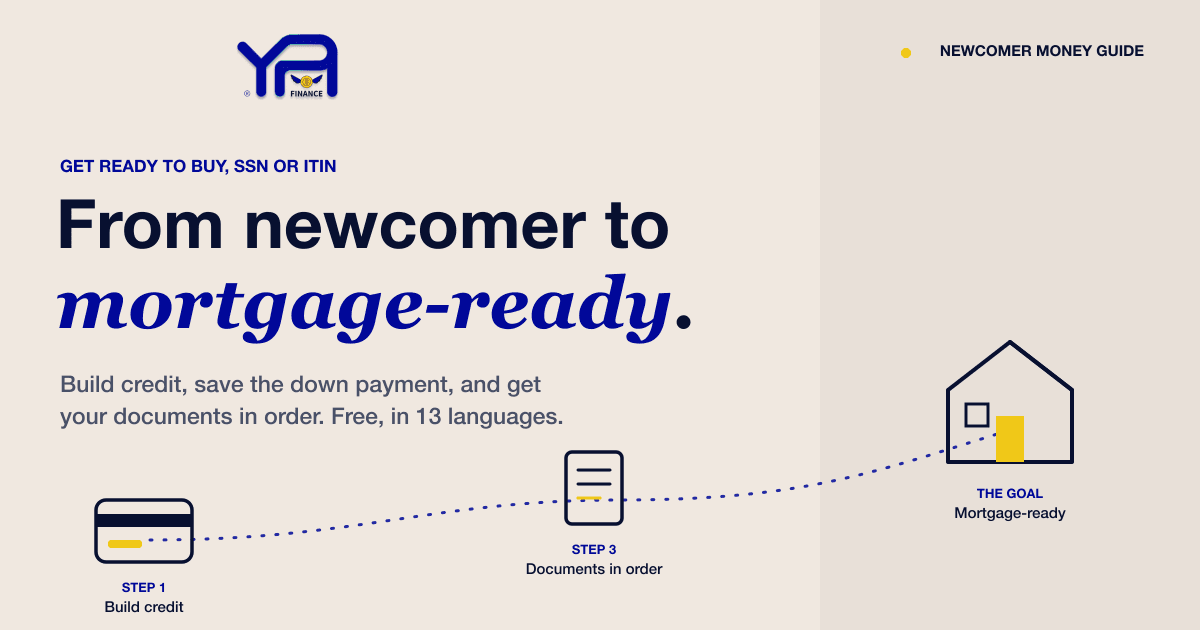
Getting financially ready to buy a US home rests on three pillars: build credit, save the down payment, and get your documents in order. Plan for about 3% down on a conventional loan, 3.5% with FHA, or 10–20% for an ITIN mortgage, plus 2–5% in closing costs. The path works whether you have an SSN or only an ITIN.
Getting financially ready to buy a home in the US comes down to three things you control long before you ever talk to a lender: build your credit, save a down payment, and get your documents in order. This is true whether you have a Social Security Number or only an ITIN. Here is how to get ready, step by step, so that when you do apply you do it from a position of strength.
Most newcomers are not turned away from a home loan on closing day. They fall short much earlier, because the financial groundwork was not in place, or they never feel ready enough to start. That groundwork is entirely in your hands, and you can begin years before you make an offer. This guide is about getting ready, not the closing-day mechanics. When your preparation is done and you want to see how that credit turns into a loan, the companion piece on how a credit card leads to a mortgage walks that path in detail.
Step 1: Build the credit a lender will want to see
A mortgage lender wants evidence you have borrowed and repaid reliably. With no US history you start at zero, and the most common way to build it is a credit card or credit-builder product used responsibly: pay on time, every time, and keep your balance well under your limit. On-time payment history is the single biggest factor in a US credit score, about 35% of a FICO score (myFICO). A score usually appears after about six months of reporting, then strengthens over a year or two. The full mechanics are in how to build credit from zero.
If you have an SSN, this is the standard path toward a conventional or FHA loan. If you do not, the same on-time history still counts toward an ITIN mortgage (Step 4).
Step 2: Save your down payment (and know your real number)
How much to save depends on the loan you will eventually use:
At a glance:
| Loan path | SSN required? | Typical down payment | Mainly offered by | Credit basis |
|---|---|---|---|---|
| Conventional | Yes | As low as ~3% (qualified first-time buyers) | Most banks and brokers | SSN-based credit file |
| FHA | Yes | ~3.5% (credit score 580+) | FHA-approved lenders | SSN-based credit file |
| ITIN | No (ITIN instead) | Often ~10–20% | Credit unions and CDFIs | Bank and utility history can substitute |
Save for closing costs on top of the down payment too, commonly in the 2–5% of the home's purchase price range (CFPB). Turning a vague "someday" into a specific number is what makes the goal real. YPA-FINANCE's budgeting and cash-flow tools help you set that number and reach it in your own language.
Step 3: Get your documents in order
This is where newcomer applications most often stall, so prepare it well before you apply. Lenders generally want:
Exact requirements vary by lender; this is the typical set, not a guarantee. Gathering it early is part of being ready, not a last-minute scramble.
Step 4: Know which path you are preparing for (SSN or ITIN)
Knowing the requirements in advance shapes how much you save and what you gather, which is the whole point of getting ready:
When your credit, savings, and documents are all in place, the next step is asking a lender for a verified pre-approval. That is the moment your preparation pays off, and the natural end of getting ready.
A readiness timeline
Everyone's pace is different, but the order rarely changes:
A note on down payment assistance
Many states and cities run down payment assistance (DPA) programs, and some also serve first-time buyers with modest incomes. Eligibility for borrowers without an SSN varies a lot by program, so do not assume you qualify or that you do not. Research the specific program's rules early, while you are still saving, and ask a HUD-approved housing counselor, so any help is built into your plan rather than discovered too late. You can find one through the CFPB's housing counselor locator.
A few readiness mistakes to avoid
A handful of habits quietly set newcomers back, and every one of them is avoidable:
Common questions
What credit score do I need to be ready to buy a home?
There is no single magic number, but the stronger and longer your on-time history, the better your options and your rate. Build it with a credit card or credit-builder product paid in full each month; on-time payments are about 35% of a FICO score.
How much should I save before buying a home as a newcomer?
Plan for the down payment plus closing costs. Down payments range from around 3% (conventional) or 3.5% (FHA) for SSN holders to roughly 10–20% for ITIN loans, with another 2–5% of the price for closing costs.
Can I get financially ready without a Social Security Number?
Yes. ITIN mortgages let you use an Individual Taxpayer Identification Number instead of an SSN. They usually expect a larger down payment and more documentation, so prepare for that as you save and gather records.
What documents should I prepare in advance?
Typically about two years of tax returns and employment history, recent pay stubs, several months of bank statements, and, for ITIN borrowers, bank and utility payment history in place of an SSN-based credit file.
How long does it take to get financially ready?
Often a year or more, mostly because credit takes about six months to appear and longer to strengthen. Saving and document prep can run in parallel, so starting early on all three is what shortens the wait.
YPA-FINANCE helps immigrants and newcomers understand credit score, budgeting, and debt payoff in 13 languages, with simple tools, plain language, and support that feels human.
Related Articles
About this page
Written and reviewed by Svetlana Burninova, CTO & Co-Founder, YPA-FINANCE. Last reviewed: .
How we write and review our content
Spot an error? Email hello@ypa.finance.