

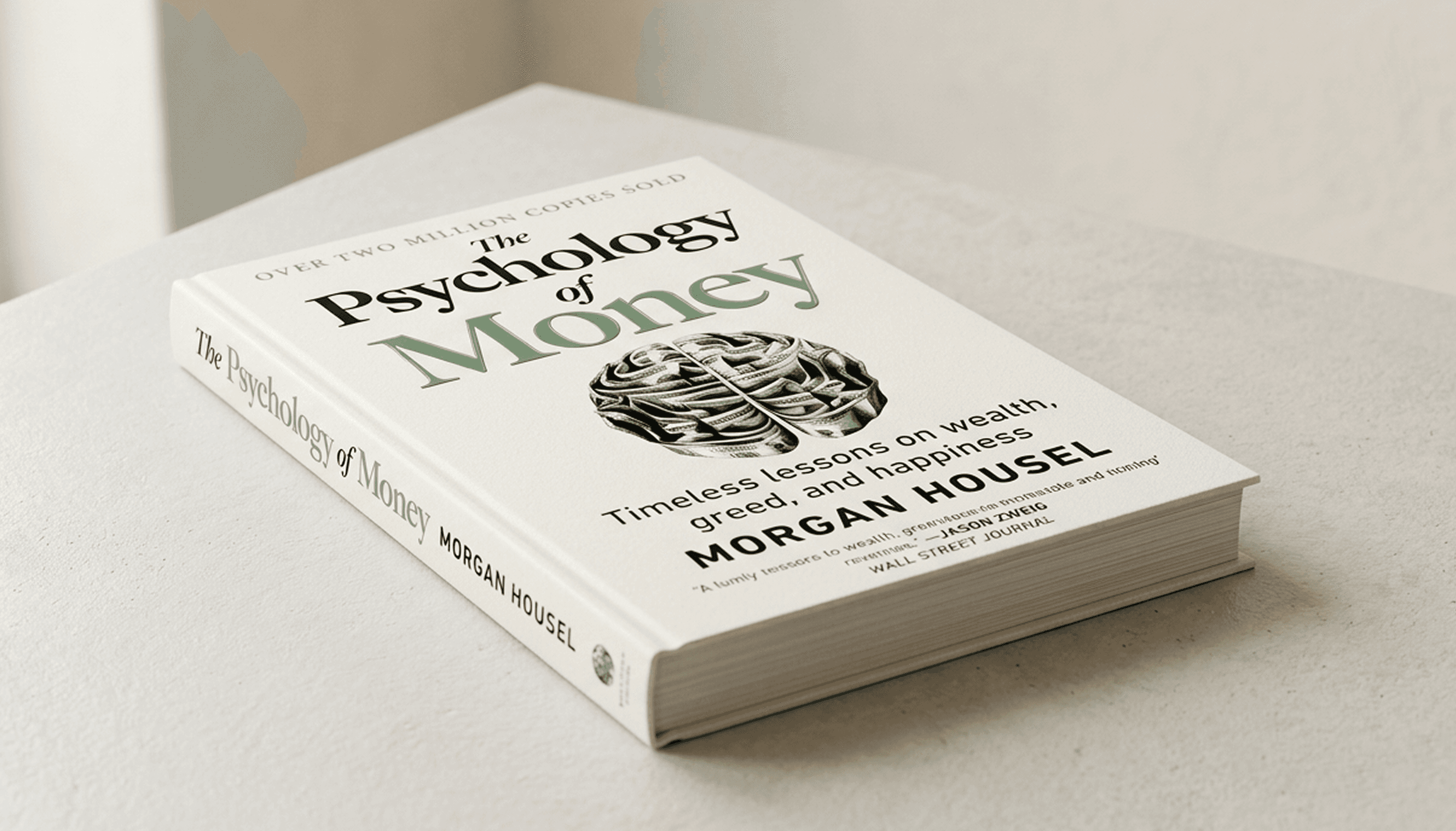
I first read this book a few years ago, and I re-read it again this week.
I still think it’s one of the best books ever written about money.
Not because it teaches investing tricks or budgeting hacks.
Because it explains something much deeper: money is not just math. It’s behavior. It’s emotion. It’s fear, ego, culture, and survival.
That idea stayed with me.
Morgan Housel writes about the fact that financial success is shaped less by intelligence and more by patience, self-control, risk tolerance, and understanding what “enough” means. Two people can earn the same amount of money and end up in completely different places — simply because they think differently, fear differently, and behave differently.
As someone who moved to the U.S. and had to learn an entirely new financial system from scratch, this book hit me harder than most finance books do. It explained something I had felt for years but never fully put into words:
People do not make money decisions in spreadsheets. They make them through the lens of their life experience.
Why this book matters — especially for immigrants
Most money advice is written by people who grew up inside the system.
It assumes you already know how credit works.
It assumes your family trusted banks.
It assumes someone taught you how to save, invest, or think long-term.
But many people did not grow up with that.
Some grew up in countries where inflation destroyed savings. Some saw banks fail. Some watched parents lose everything. Some learned that cash was safer than institutions. Some were taught to avoid risk at all costs.
So when people behave “irrationally” with money, they usually are not being irrational at all. They are reacting to what life taught them.
That is one of the most powerful ideas in this book:
no one is crazy with money.
People are shaped by different experiences, different fears, and different definitions of safety.
Lessons from the book that stayed with me
1. “Enough” is a superpower
One of the hardest financial skills is knowing when something is enough.
There will always be someone with more. More money, more status, a bigger house, a better title. If you never define what “enough” means for you, the goalpost will move forever.
2. Compounding only works if you stay in the game
We love dramatic success stories, but Housel reminds us that wealth often comes from consistency, not brilliance.
The magic is not just earning returns. The magic is not interrupting the process.
3. Wealth is what you don’t see
A lot of people confuse spending with wealth.
Nice cars, expensive clothes, visible success — those things may look impressive, but they are not the same as financial security. Real wealth is often invisible. It’s the money you didn’t spend. The cushion. The flexibility. The ability to breathe.
4. Getting money and keeping money are different skills
Building wealth often requires optimism, action, and risk. Keeping wealth requires humility, restraint, and survival.
That lesson matters far beyond finance.
5. Financial freedom is control over your time
One of the most beautiful ideas in the book is that the highest form of wealth is not status. It is control.
The ability to choose.
To leave.
To wait.
To say no.
To not panic.
That is what money can give you at its best.
6. Your money habits come from your story
People do not think about money in a vacuum. They inherit beliefs.
What your family feared.
What they admired.
What they never had.
What they lost.
Those stories shape decisions more than most people realize.
7. Saving without a specific reason is powerful
Not every dollar needs a named destination.
Sometimes saving “just in case” gives you the most valuable thing of all: options.
For many immigrants, that is not luxury. That is protection.
8. Behavior matters more than intelligence
This may be the biggest lesson in the whole book.
Doing well with money is usually not about being the smartest person in the room. It is about having habits that protect you from your own worst impulses.
Why this book matters to me as a founder
Re-reading this book reminded me why so many financial tools fail people.
They assume the problem is information.
But often, the problem is not lack of information.
It is fear. Shame. Confusion. Language. Overwhelm.
It is feeling like finance was built for someone else.
That is why this book still feels so relevant.
People do not only need better numbers.
They need clarity. Calm. Confidence.
They need financial guidance that meets them where they are.
Final thought
The biggest lesson from The Psychology of Money is simple:
Good decisions with money are rarely flashy.
They are quiet. Repeated. Boring, even.
Save a little.
Wait a little.
Define enough.
Stay in the game.
That is true in personal finance.
And honestly, it is true in life.
Should you read it?
Yes.
Whether you are just starting to understand money or have been thinking about it for years, this book will likely change how you see financial behavior — your own and everyone else’s.
It is short, clear, and one of the few money books that feels deeply human.
If I could recommend one book about money to someone trying to build a more peaceful relationship with it, this would be near the top of the list.
Book:The Psychology of Money: Timeless Lessons on Wealth, Greed, and Happiness by Morgan Housel
YPA Finance makes credit score, budgeting, debt payoff, and personal finance easier to understand with simple tools, plain language, predictive insights, preventive alerts, and support in 13+ languages.
Tags:
Building wealth
Financial advice for immigrants
Personal finance USA
Beginners
Money Tips
First-Generation Families
Founder diary
Immigrant Finance
Telegram
Customer Support
Product Updates
Money mindset
Psychology of money
APR
Credit cards
Personal finance
Credit building
Financial literacy
Immigrants
Credit score

Contacts:
email: hello@ypa.finance
YPA Group Inc.,
131 Continental Drive Suite 305
Newark Delaware 19713
United States


Educational use only. Not financial advice. Please consult a licensed professional for financial decisions.
© 2024–2025 YPA Group Inc.™ DBA YPA Finance™. All Rights Reserved.